
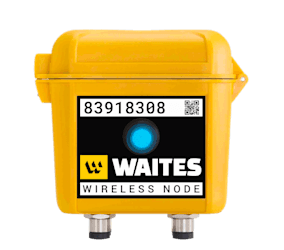
From Reactive Maintenance to Continuous Visibility
Condition monitoring has long been used to identify early signs of equipment failure. Traditionally, these programs relied on manual inspections or complex wired systems that were typically installed only on critical assets.
Improvements in wireless monitoring technologies are changing that.
By combining permanently mounted sensors, cloud connectivity, and improved backend analytics, systems such as Waites Wireless Monitoring allow maintenance teams to monitor more equipment continuously, without the cost and disruption of wired infrastructure.
For Anthony O’Keefe, National Engineering Services Manager at Motion, this growing adoption reflects the pressures facing industrial operations.
“Industrial operations are under increasing pressure to reduce unplanned downtime, extend equipment life, and operate with lean maintenance teams,” O’Keefe says.
“Traditional reactive maintenance simply can’t keep up. Manual inspections are time-consuming and inconsistent, and wiring every asset for monitoring is often cost-prohibitive.”
Wireless monitoring helps address this by expanding visibility across more of the plant.
“Wireless condition monitoring makes it possible to monitor more of the plant, not just a handful of critical assets,” he says. “It gives maintenance teams a clearer picture of equipment health.”
Expanding monitoring coverage
Traditional wired monitoring systems remain important but are often limited by installation requirements.
Wireless solutions offer a more flexible alternative, enabling broader deployment across balance-of-plant assets.
“Wireless systems change the equation because of their lower cost of entry,” O’Keefe says.
“Plants can now economically monitor pumps, motors, gearboxes, conveyors, and other equipment that previously relied on manual data collection and inspections.”
This broader coverage allows teams to detect issues earlier across a wider asset base.
How the technology works
Wireless condition monitoring systems use permanently mounted sensors that measure vibration and temperature – key indicators of mechanical health. These are converted into digital data and transmitted to a gateway, then sent to the cloud, ready for analysis.
Specialist analysts then assess trends and provide recommendations if abnormalities are detected, enabling continuous monitoring without manual inspection routes.
Enabling predictive maintenance
One of the biggest benefits is the shift away from reactive maintenance.
“Continuous monitoring changes maintenance planning completely,” O’Keefe says.
“Instead of waiting for failure or relying so much on time-based schedules, teams can detect early signs of issues such as bearing wear, imbalance, or misalignment.”
This allows maintenance teams to plan work during scheduled shutdowns rather than responding to breakdowns.
“The result is fewer emergency repairs, better planning, and reduced downtime,” O’Keefe says.
Better data, better decisions
While sensor technology has improved, it is the advances in analytics where we are seeing the significant improvement in reliability outcomes.
“The technology hasn’t changed dramatically, but the analysis has become much more reliable,” O’Keefe says.
“With much larger data sets available, the algorithms used to analyse vibration patterns are more accurate. That leads to more reliable maintenance recommendations.”
As industrial operations adopt more data-driven strategies, wireless technologies such as Waites Wireless Monitoring are playing an increasing role in improving reliability, safety, and performance.


Get the latest from Motion
Get exclusive offers and content, information about news and upcoming events and so much more.