
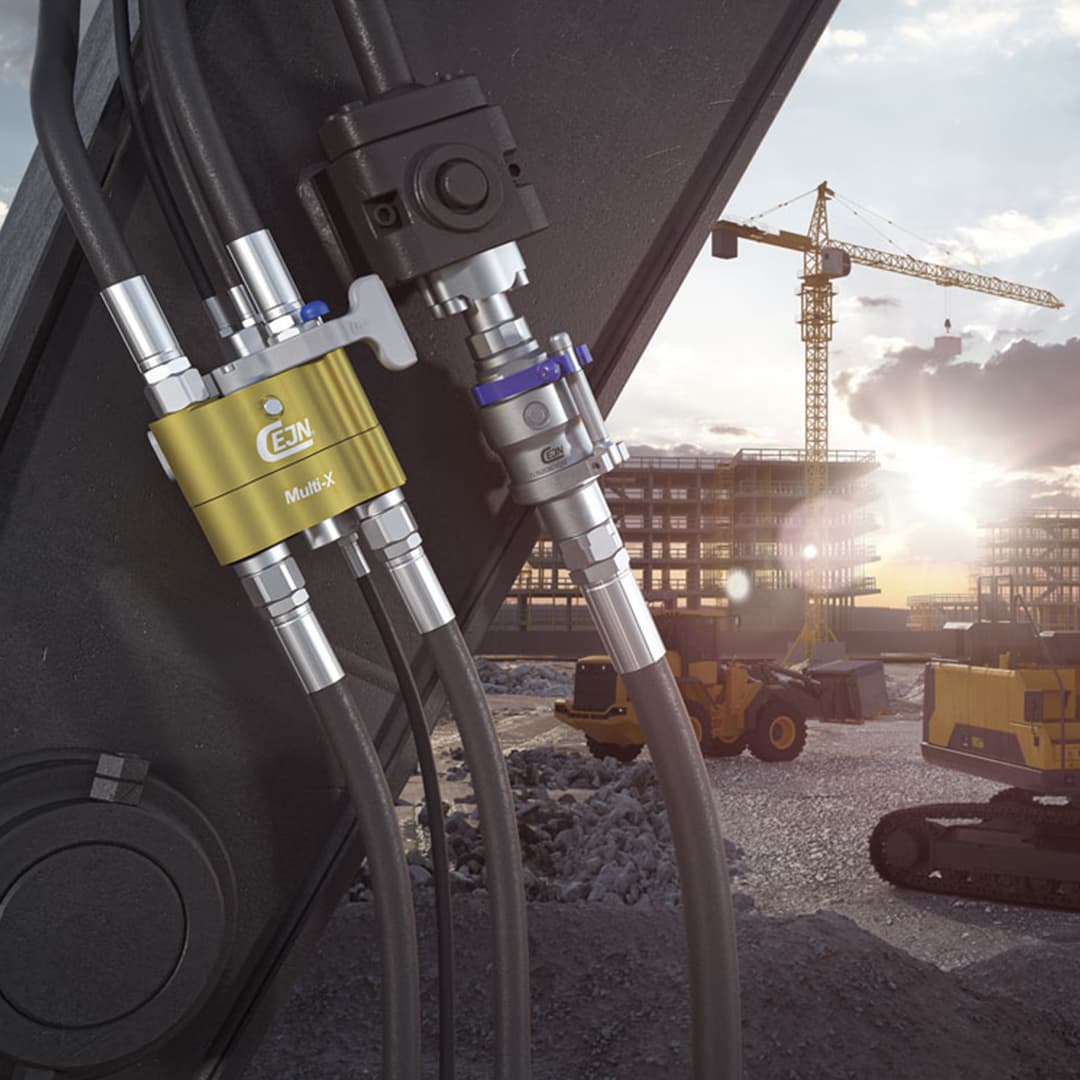
One Machine, Multiple Attachments, Constant Change
Concrete shatters under the force of a hydraulic breaker as an excavator pounds through rock and reinforced structures on a demolition site. In minutes, tonnes of material can be reduced to rubble. But breaking rock is only the beginning. The same machine may need to cycle through multiple attachments – breakers, crushers, shears, and buckets – as the job shifts from demolition to sorting, crushing, and clearing the rubble.
The challenge
Previously, switching between attachments has been a slow and disruptive process that often requires specialised tools.
“Traditionally, operators would have threaded or flanged hydraulic fittings at the hose connection point,” explains Stephen Forbes, Product Manager - Hydraulic Adaptors and Accessories at Motion. “This means stopping the machine, relieving residual circuit pressure, uncoupling and recoupling hydraulic attachments, and then re-energising the hydraulic system before you can start work again.”
Another significant risk arises when hydraulic systems are opened during attachment changeover.
“As soon as you start disconnecting hoses and opening systems up, you introduce the risk of contamination and spillages, along with the dangers associated with high-pressure oil injection from hydraulic lines,” Forbes says. “Maintaining system cleanliness is critical to efficient operations while spillages can result in significant environmental impacts and clean-up costs. High-pressure oil injection injuries are almost always very serious events and mitigating any risk of these types of events should always be top of mind for people working with hydraulic systems.”
The solution
To address these challenges, hydraulic couplings designed specifically for high-pressure systems used in the construction and demolition industries are becoming increasingly important. CEJN’s TLX coupling series was developed in Sweden to handle the high flow rates and pressure impulses generated by demanding hydraulic tools.
“TLX was designed for high-pressure, high-flow applications such as hydraulic hammers and demolition tools,” says Quinn Parsons, Managing Director of CEJN Australia. “These environments place enormous demands on hydraulic systems, so the coupling needs to be extremely robust while maintaining high flow performance.”
Manufactured in Sweden using high-quality steel and precision engineering, the couplings are built to withstand the harsh conditions common on construction and demolition sites.
CEJN’s newer BLX coupling is designed to simplify hydraulic tool changes in these demanding applications.
“With BLX, you have a mechanism to allow connection and disconnection even with high residual system pressure,” Forbes explains. “That means operators can change attachments much more easily and faster without needing to completely depressurise.”
Because no specialised tools are required, attachment changes can be completed more quickly while helping reduce the risk of oil spills and system contamination.
The outcome
“Applications in demolition or heavy construction place that extra stress on your hydraulic systems,” Forbes says. “Having a coupling that can handle high flow and shock loads while allowing quick tool changes makes a big difference to productivity.”
For Motion, selecting the right coupling solution is part of a broader approach to helping customers optimise hydraulic systems in demanding applications.
“Our team works closely with customers to understand how their machines are being used and what attachments they’re running,” Forbes says. “From there we can recommend coupling solutions that improve safety, reduce downtime, and keep equipment running efficiently.”


Get the latest from Motion
Get exclusive offers and content, information about news and upcoming events and so much more.