
Millisecond Precision in Motion
Inside a modern timber mill, motion is constant and rarely confined to a straight line.
Logs twist, saws pivot, and cutting systems move in real time, following complex paths designed to extract the maximum amount of usable timber from each log. What appears to be a simple cut is, in reality a constantly adjusting motion profile, executed with millisecond precision.
Precision that drives yield
In this environment, accuracy directly determines how much saleable timber is recovered and how much is lost to lower-value woodchip.
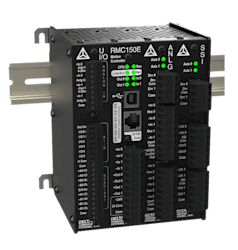
At the centre of this process are Real-Time Motion Controllers – in particular, Delta Motion’s range of RMC controllers, of which, Motion is the Australian agent – which coordinate the movement of hydraulic cylinders across equipment such as debarkers, log positioning systems, and saw lines. These systems don’t simply move and stop – they continuously track and adjust position throughout the cut.
This level of control allows mills to follow curved or irregular cutting paths, maximising recovery from each log, rather than defaulting to straight cuts.
Dynamic control in real time
Modern mills rely on real-time scanning and optimisation to determine how each log should be cut. That requires motion systems that can respond instantly and accurately as conditions change.
Servo valves play a critical role, regulating hydraulic flow to translate control signals into precise physical movement.
“If you think about it like a car, the controller is the engine management system, and the servo valve is the fuel system,” says Ian Duncan, Chief Engineer – Design & Projects at Motion.
Together, the controller and valve must operate seamlessly – one providing the intelligence, the other delivering the execution.
Maintaining performance under pressure
Even small variations in performance can affect cut accuracy and yield, placing additional stress on both equipment and operations.
Motion supports these systems through both engineering expertise and specialised repair capability. The company operates a dedicated servo valve repair facility, handling hundreds of valves each year from across Australia and Southeast Asia. Each valve is tested, repaired, or rebuilt, and validated to meet original equipment specifications before returning to service.
Engineering beyond components
Achieving reliable motion control in timber processing environments requires more than hardware. It demands expertise across hydraulics, software, mathematics, and system integration.
Mastery of this combination of disciplines positions Motion as Australasia’s premier electro-hydraulic engineering business, designing and building dozens of high precision servo-hydraulic systems every year, along with a range of support services to diagnose specific performance issues, refine control strategies, and ensure systems operate at the required level of precision.
Where precision meets profitability
In an industry where margins are measured in recovery rates and product consistency, control performance has a direct commercial impact. More accurate motion means more usable timber, tighter tolerances, and less waste.
As mills adopt more advanced scanning and automation technologies, the demand for precise, responsive motion control will only increase. Behind every accurate cut is a tightly integrated system of controllers, valves, and engineering expertise working in sync.
“It’s about following a complex motion profile and being exactly where you need to be every millisecond,” says Duncan.


Get the latest from Motion
Get exclusive offers and content, information about news and upcoming events and so much more.