
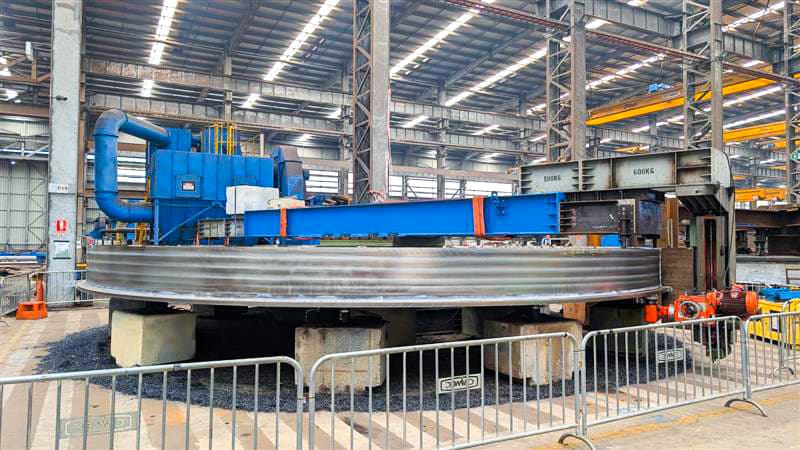
Precision In-Situ Machining for Large-Scale Industrial Assets
In a perfect world, machining happens in a controlled workshop, on fixed machines, with clean access and stable conditions. In heavy industry, that ‘perfect world’ rarely exists. Large mining assets and support infrastructure are often built, assembled, or refurbished in ways that make conventional machining impractical.
That’s where Motion’s in-situ machining team comes in – using portable, purpose-built tooling to complete precision work directly on-site, without the delays and risk that come with moving oversized components.
Harrison Hart, Operations Manager at Motion, says the key trigger is scale. “This specific work is machining on things that are so big you can’t actually put them on a machine in a workshop – so they need to be done in-situ,” he explains.
The challenge
In mining and bulk materials handling, one common pressure point is large rail unloading infrastructure – equipment designed to move and process thousands of tonnes per hour, where mechanical interfaces must be machined accurately to ensure reliability and safe operation.
For instance, Motion has maintained an ongoing working relationship with a large iron ore customer machining components for rail car dumpers – a machine that clamps onto a loaded rail wagon, rotates it through 360 degrees, and empties ore onto a conveyor for stockpiling and ship loading. Components are often massive, and tolerances still matter.
Building this kind of equipment, the challenge is that fabrication capability and machining capability are not always the same thing. “Their core work is fabrication – cutting steel, welding it together, and assembling,” Hart says. “This is specialist machining work, on assemblies that can’t be moved easily.”
The other challenge is time. Large mining builds run to tight schedules and long lead times. When a machining task sits on the critical path, it needs to be completed quickly, correctly, and with minimal disruption to other work fronts.
The solution
Motion’s approach is to combine a workshop-level engineering mindset with field-ready execution. Portable rigs and custom tooling are designed around the job at hand, then set up on site to machine the asset in place.
Even when the task is familiar, the setup rarely is. “The task itself is the same, and we’ve done it in many different places,” Hart says. “But the way you actually set it up and use the tools is different almost every time. It’s very bespoke to the specific piece of equipment you’re working on.”
Repeat projects can also unlock momentum. As identical assets are built in sequence, Motion can refine methods, reduce setup time, and improve throughput. “This is the second time we’re running through it,” Hart notes. “There’s process improvement and efficiency gains because we’re doing the same task again.”
Resourcing is scaled to match demand. Motion typically maintains a steady on site presence, then flexes up for peak activity. “It ebbs and flows,” Hart says. “There are times we need more resources, overtime, or night shift – we move our team to meet what the customer needs.”
For mining customers, the value is straightforward: specialist capability on demand, delivered close to where the
work happens. “It’s really niche work – there’s not many people in Australia that do this kind of work, setting Motion apart from the rest” Hart says.

Get the latest from Motion
Get exclusive offers and content, information about news and upcoming events and so much more.