
The Overlooked Role of Compressed-Air Equipment Near Food Production Lines
Compressed air is common in food and beverage production, but the equipment that delivers it can be easy to overlook.
Hose reels, couplings, and blow guns are often used around production lines to clear debris, remove product build-up, and clean down machinery, conveyors, or processing equipment. They may not be part of the core production line, but they can sit directly beside it.
As Paul Cavicchiolo, Category Manager Hydraulic Hose & Connectors at Motion explains, that proximity matters.
“It’s basically not a part of the production line, but it’s next to the production line,” he says. “The person that’s using it is on and around the production line of any kind of food or beverage, just to clear equipment. There might be build-up of meat on a mixer, or it might be clearing a conveyor, a roller, or something that’s gathering foodstuffs along the way.”
The problem
In food processing environments, standard industrial pneumatic equipment can create avoidable risk.
Materials not suited to food and beverage areas may be harder to clean, may not meet food-contact regulatory requirements, or may create issues if damaged components enter the production process. Inconsistent equipment across different production areas can also make maintenance, quality assurance, and audit documentation more difficult.
“If materials used within the products themselves are not FDA-compliant or food-grade, they can absorb food materials,” says Cavicchiolo. “Through this absorption, you might get bacterial growth and contamination that way.”
Matt Davidson, National Sales Manager at CEJN, says manufacturers should understand the role of HACCP before selecting pneumatic equipment for food and beverage areas. HACCP, or Hazard Analysis and Critical Control Points, is the system used by food manufacturers to identify where contamination risks can occur and put controls in place to manage them.
“Food and beverage manufacturers should recognise that HACCP is a preventive framework used to identify and control contamination risks, rather than a product certification itself,” he says. “Pneumatic equipment must therefore support HACCP plans by using food-grade materials that are suitable for contact or incidental contact, by being easy to clean, and resistant to harsh environments.”
The solution
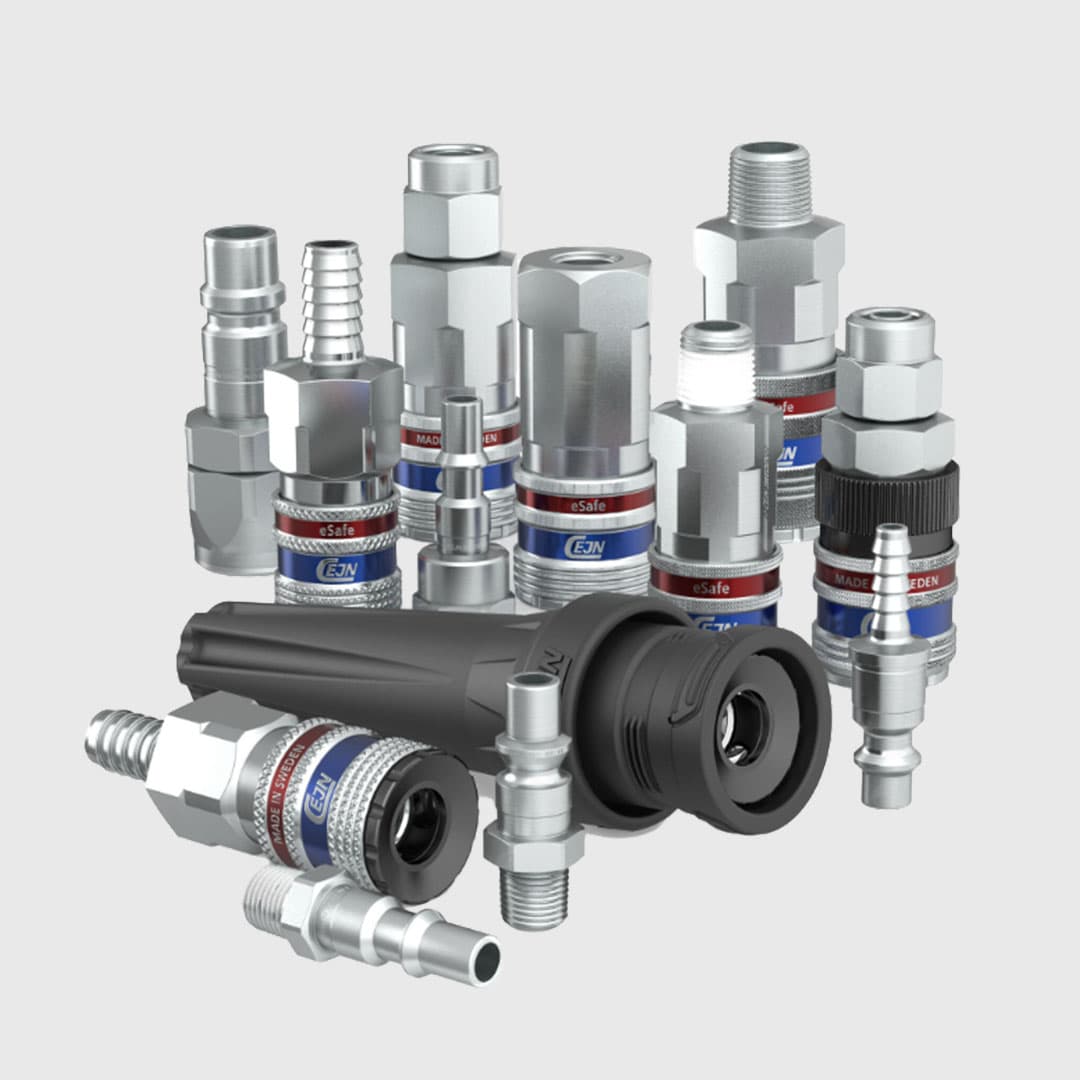
CEJN’s food and beverage pneumatic range is designed as an integrated system. A typical setup may include a CEJN SafetyReel FS hose reel, eSafe coupling, and 208 Detect blow gun, creating a complete pneumatic point-of-use for compressed air applications around production.
Food-grade compressed air depends on every component it passes through. While compressors, dryers, and filters are often selected to meet food and beverage requirements, the hose reel also forms part of the airflow path and must meet the same hygienic standard. In CEJN’s food and beverage system, this includes the plastic housing, compressed air PUR hose, stop ball, nipples, quick couplings, stainless steel wall bracket, seals, and grease, with relevant components designed to comply with FDA and EU food-contact regulations.
“CEJN products work together to ensure a safe system, ” says Cavicchiolo. “You have the hose and the hose reel, then you have the eSafe connector on the end of the hose, and then the blow gun that plugs into that connector.”
Davidson says the range is designed to maintain safety and hygiene across the compressed air workflow.
“SafetyReel FS hose reels provide controlled, food-safe hose management in washdown and production environments; eSafe couplings ensure safe, low-risk connections with food-approved materials and pressure-relief disconnection; and the 208 Detect blow gun enables safe cleaning with fully detectable, food-safe components,” he says.
The 208 Detect blow gun is designed to support foreign object control. Its detectable materials help metal detection and X-ray systems identify foreign objects before products leave the facility.
“The blow gun is lighter than traditional stainless steel metal guns, so you reduce operator fatigue by reducing the weight,” says Cavicchiolo. “It’s also not as cold to the touch as the steel ones.”
He says detectability is the key food safety feature. “First and foremost, it’s detectable by the X-ray and metal detection systems in food processing,” he says.
The outcome
Davidson says features such as detectable materials, food-safe components, vented safety couplings, controlled hose retraction, and cleanable surfaces all help during audits and contamination-control reviews.
“These features directly support audit outcomes by demonstrating proactive contamination control, traceability, and alignment with HACCP principles,” he says.

Get the latest from Motion
Get exclusive offers and content, information about news and upcoming events and so much more.