
Built to Withstand Harsh Mining Environments
When machinery is working hundreds of metres underground, the smallest failure can mean big trouble. Bearings in particular are a known weak point in mining operations – often exposed to dust, ground water, vibration, and heat that push standard units beyond their limits.
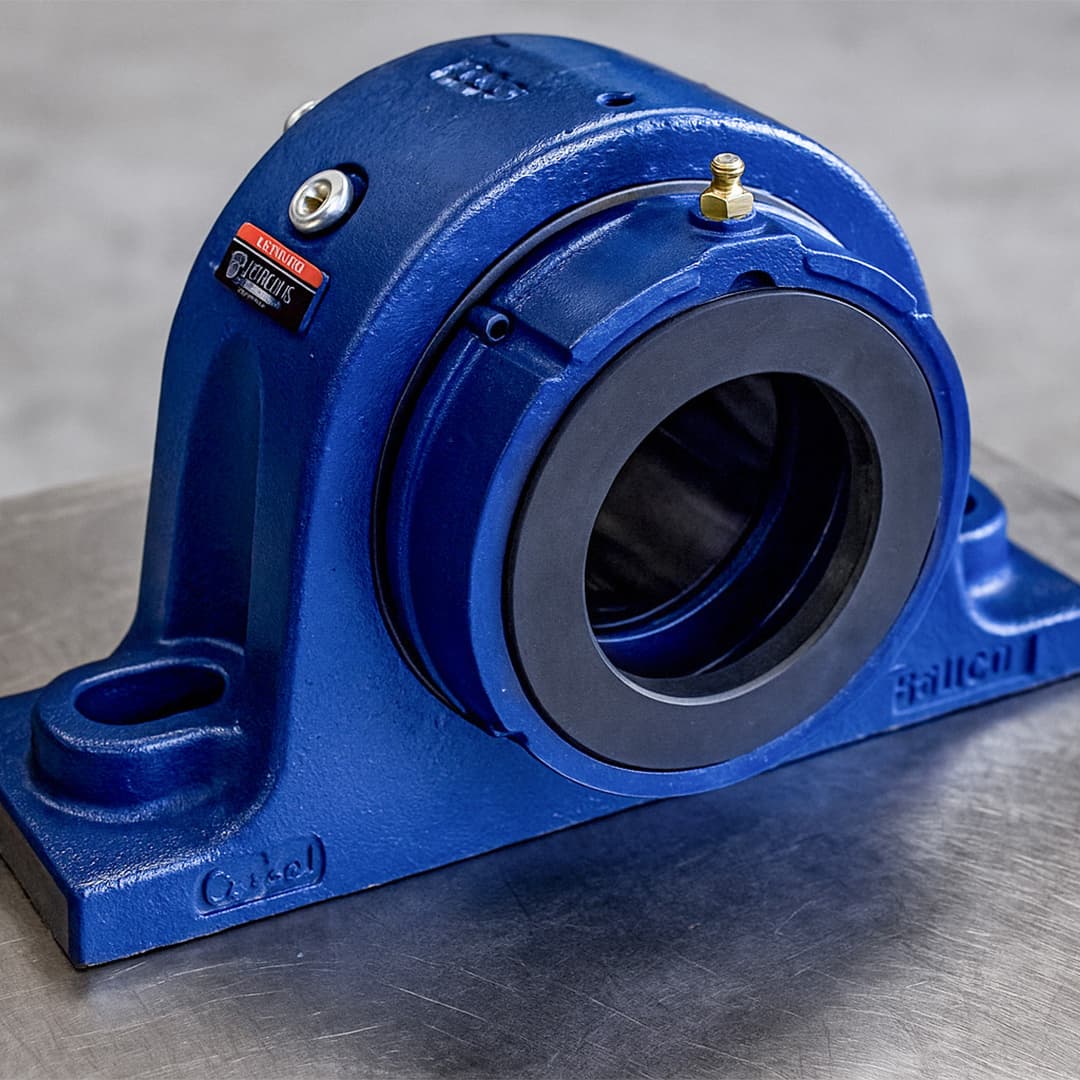
That’s where Timken’s solid-block housed bearing units come into their own.
“These are designed to thrive in extreme environments,” says Tony Tormey, Category Manager for Industrial Bearings at Motion. “In heavy industry – and especially in mining – we see a lot of premature bearing failure due to contamination or incorrect installation. Timken’s solid-block units are purpose-built to solve those problems.”
The secret lies in the construction. Unlike traditional split-housing units, Timken solid-block housed bearings are made from a single piece of cast steel. That gives them superior strength and rigidity under load. But just as importantly, each unit is assembled at the factory – with pre-set internal clearances, integrated seals, and a choice of shaft locking options. Timken’s latest shaft locking option, TAA, combines an adaptor sleeve, with a withdrawal nut, which is already pre-positioned at the back of the bearing, to locate the bearing on the sleeve, setting the internal radial clearance automatically.
“It’s a one-piece solution,” says Sean Young, General Manager for Regional Sales at Timken. “You don’t expose the bearings, when fitting the housing on-site, or manually measure the radial internal clearance. The TAA sleeve arrangement does this for the fitter, as it’s all been done for you at the factory. You just bolt it on to the mountain structure, tighten the TAA sleeve nut (externally) and the housing is ready for operation.”
That level of convenience also helps avoid what Young calls “C.L.I. disease” – Contamination, Lubrication, and Installation errors. These are the top three causes of bearing failure in industrial environments, and Timken’s housed units are engineered to mitigate all of them.
“Each unit is sealed, greased, and tested before it leaves the factory,” Young explains. “It comes as a fixed (non-expansion) unit, which can be easily converted into a floating (expansion) unit, so you can set up for any application easily without exposing the bearing to the mine environment. That keeps contaminants out and ensures longer service life.”
For maintenance teams working under pressure, that can make all the difference.
“Installation time is dramatically reduced,” says Tormey. “We've seen sites where they were spending a full day replacing bearings on a tricky conveyor – and with Timken, they’ve got it down to under 90 minutes.”
That reduction in labour hours, combined with longer service intervals and fewer unplanned breakdowns, translates directly to cost savings. But perhaps more importantly, it boosts safety and reliability in high-risk environments.
“Anything we can do to reduce time spent in the field – especially in mining – is a win,” says Fabio Rebecchi, National Product Manager. “It means less risk to workers, more uptime for assets, and fewer variables for site engineers to manage.”
The strength of Timken’s product is backed by deep technical support – not just from the Timken team, but from Motion’s national branch network. Training, site visits, and engineering support are part of the package.
“Our people don’t just drop off boxes,” says Tormey. “We support customers to select the right solution, install it correctly, and get the most out of their equipment. That’s where Motion adds real value.”
And while the Timken solid-block housed unit has fans across a range of industries, it’s in mining where the difference is most pronounced.
“This product is a favourite for good reason,” says Young. “It’s built to handle the toughest jobs, last longer, and make life easier for the people using it. That’s what good engineering should do.”

Get the latest from Motion
Get exclusive offers and content, information about news and upcoming events and so much more.